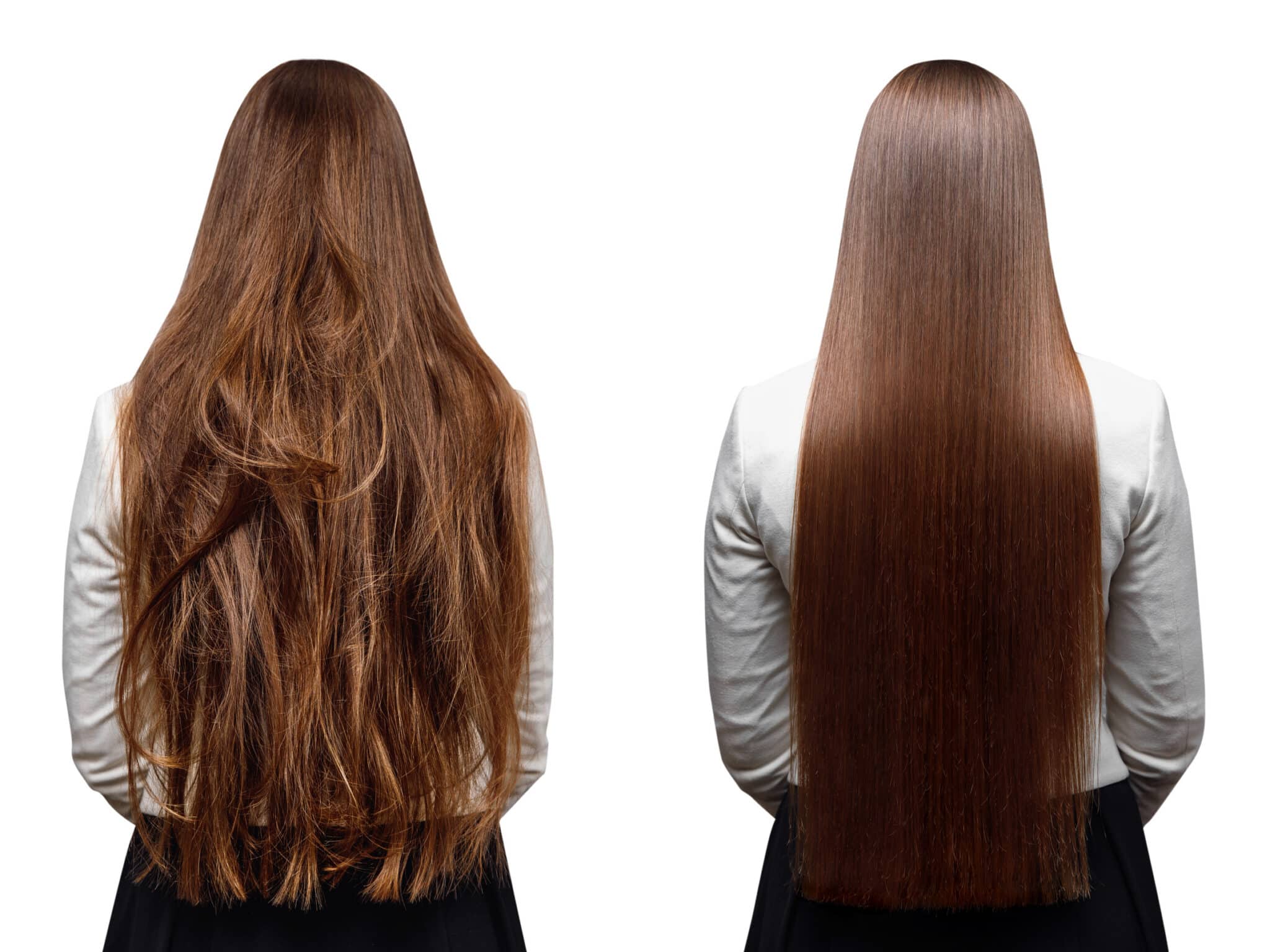
You have spent enough mornings fighting frizz to know that a blow-dryer alone is not the answer. Somewhere between the third round brush pass and the humidity outside, the idea of a smoothing service starts to sound less like a luxury and more like a practical decision.
Then the research begins, and the keratin treatment vs Brazilian blowout question stalls everything, because both promise smoother hair and neither explains who it is actually for. The confusion is understandable.
The two services share ingredients, overlap in marketing language, and are often used interchangeably by people who have never performed either one. What separates them is formulation, process, how much natural texture remains afterward, and how the result behaves over the following months. Those distinctions matter far more than the name printed on the bottle.
Ahead, each service is taken apart the way a stylist would explain it at the chair: how it works at the hair shaft, how long results realistically hold, what aftercare each demands, and which suits which texture, with the trade-offs stated plainly.
The Essential Differences at a Glance
A keratin treatment and a Brazilian blowout are both smoothing services, not straightening treatments. Neither permanently alters the internal bond structure of the hair: the way a relaxer or Japanese straightening does.
The traditional keratin treatment saturates the hair with a keratin-based solution, then seals it with heat. Results tend to be softer and more flexible, reducing frizz while allowing some natural curl to remain. A Brazilian keratin treatment, often marketed as a Brazilian blowout, uses a different chemistry and typically delivers a more sealed, glossier surface with faster styling.
Keratin Treatment vs Brazilian Blowout at a Glance
- Keratin treatment: deeper conditioning effect, softer finish, more curl pattern preserved, usually requires a waiting period before the first shampoo.
- Brazilian blowout: surface-sealing formula, sleeker and shinier finish, hair can generally be washed the same day.
- Both: reduce frizz, cut blow-dry time, and loosen texture without erasing it entirely.
What Both Smoothing Services Can and Cannot Do
Both services excel at humidity resistance. They tame the swelling and puffing that occurs when moisture in the air pushes into a raised hair cuticle.
Neither service will turn tight curls into pin-straight hair in one appointment. What they will do is reduce volume, soften the curl pattern, and make heat styling dramatically faster. Expecting a relaxer result from a smoothing service is the single most common source of disappointment.
Why Results Depend on the Formula and Application
Two clients can receive the same product and walk out with different results. Porosity, previous chemical services, natural texture, and density all influence how much solution the hair absorbs and how evenly it holds.
Application technique carries equal weight. Sectioning, saturation, drying percentage, and flat iron passes determine whether the treatment sets properly or fades within weeks. That variability is exactly why the chemistry behind each service is worth knowing.
How Each Service Smooths the Hair
Smoothing works by reshaping how the hair holds moisture and how tightly the cuticle lies flat. The two services approach that goal from different directions.
Keratin Protein and the Hair Shaft
Keratin is the structural protein your hair is already made of. Damage, coloring, and heat gradually strip it, leaving gaps along the hair shaft that read as frizz, roughness, and dullness.
A keratin treatment deposits hydrolyzed keratin and amino acids into those weakened areas. Research on keratin-based particles for hair has documented increased surface smoothness after treatment, along with measurable changes in the protein structure. The result is hair that feels denser and reflects light more evenly.
Amino Acids and a Surface-Smoothing Finish
Brazilian-style formulas lean more heavily on a protective protein layer that wraps the outside of the strand. Rather than filling from within, the solution bonds around the cuticle to create a sealed, water-resistant shell.
That difference explains the finish. Surface-sealing services often look glossier immediately. Protein-filling treatments improve the way hair feels over the following weeks. Both approaches leave the disulfide bonds intact. This is why the change is temporary and grows out softly instead of leaving a hard demarcation line.
The Role of Heat and the Flat Iron
Heat is not an afterthought in either service. The flat iron pass is what sets the treatment, locking the solution into position as the hair cools.
Temperature must be calibrated to the client's hair. Fine or previously lightened hair requires lower heat and fewer passes. Coarse, resistant hair needs more. Getting this wrong is how smoothing services earn a reputation for damage they do not inherently cause. Once the treatment sets, the real question becomes how long the smooth hair will actually last.
Results, Timing, and Maintenance Expectations
Longevity is where the two services separate most clearly for the client's calendar and budget. Both fade gradually rather than ending abruptly.
How Long a Keratin Treatment Lasts
A traditional keratin treatment typically holds for three to five months, depending on hair type and washing frequency. Coarse, dense hair often retains the result longer than fine hair, which sheds the protein faster.
Many formulas ask you to wait 48 to 72 hours before the first shampoo, avoiding ponytails, clips, and tucking hair behind the ears. That window allows the treatment to fully cure. Skipping it is one of the fastest ways to shorten your results.
Brazilian Blowout Longevity and Immediate Styling
Brazilian-style smoothing usually lasts around ten to twelve weeks. The trade-off for slightly shorter longevity is convenience: most versions allow washing and styling the same day, with no waiting period at all.
Blow-dry time drops noticeably with either service. Clients who once spent forty minutes with a round brush often finish in fifteen. Many air-dry with acceptable results for the first time in years.
Aftercare That Protects a Smoother Finish
Aftercare is not optional. Sodium chloride and harsh detergents strip smoothing treatments faster than anything else in your routine.
- Switch to sulfate-free shampoos and matching conditioners. This single change extends results more than any other habit.
- Skip clarifying shampoo entirely unless a stylist recommends it, as it is designed to remove exactly what the treatment deposited.
- Rinse thoroughly after swimming, since chlorine and salt water accelerate fading.
- Use a heat protectant even on lower-heat styling days.
- Space out other chemical services rather than stacking them close together.
When to Repeat a Smoothing Service
Most clients rebook a keratin treatment every four to six months and a Brazilian-style service every three months. Rather than waiting for the smoothing to vanish, plan the next appointment as the frizz begins to return.
Color-treated hair adds a scheduling layer. Color is generally applied before smoothing, or spaced at least two weeks after, to protect tone and deposit. How those timelines fit your life depends heavily on the hair you are working with.
Matching the Service to Hair Type and Lifestyle
The right choice is rarely about which service is better in the abstract. It is about texture, condition, and how much time you are willing to spend each morning.
Considerations for Curly, Wavy, and Coarse Hair
Curly and coarse hair generally responds beautifully to smoothing, but the goal must be defined honestly. If you want to keep a defined curl pattern with less frizz, a lighter keratin application preserves more shape.
Wavy hair sits in an interesting middle ground. A full-strength service can flatten waves more than expected, leaving hair that looks limp rather than polished. Adjusting saturation and iron passes lets a stylist soften texture without erasing it.
Very coarse, high-density hair often benefits from the stronger sealing effect. The priority is usually volume control and cutting blow-dry time in half.
Considerations for Fine, Thin, and Color-Treated Hair
Fine and thin hair requires restraint. Too much product weight or too many hot iron passes can leave hair looking flat and lifeless, with less body than before.
Damaged or heavily lightened hair needs an honest condition assessment first. Blonde hair that has been through multiple lightening sessions may need strengthening and repair before any smoothing service is appropriate. A color correction history is particularly relevant, since compromised hair absorbs unpredictably.
Color-treated hair can absolutely be smoothed. It simply requires sequencing, gentler heat, and a stylist who understands how the treatment will interact with existing tone.
Choosing Based on Frizz, Volume, and Daily Routine
Ask yourself what you actually want to change. Frizz reduction, volume reduction, and speed are three different goals, and they point toward different formulations.
- Mostly frizz, want to keep texture: a lighter keratin application.
- Want maximum sleekness and shine: a stronger sealing formula.
- Travel often, wash frequently: the shorter cure time is a practical advantage.
- Prefer the longest possible interval between services: the longer-lasting option usually wins.
Lifestyle matters as much as texture. Someone swimming four mornings a week in Buckhead has a different maintenance reality than someone who washes twice weekly. That personal picture is what a proper consultation is built to capture, alongside the safety questions every client should be asking.
Safety, Hair Health, and a Personalized Consultation
Smoothing services deserve straightforward conversation about ingredients. A reputable salon will discuss formulas openly rather than deflecting.
Questions to Ask About Formaldehyde and Formula Transparency
Formaldehyde risk is the most legitimate concern surrounding hair-smoothing treatments. Many modern formulas rely on formaldehyde releasers such as methylene glycol, which can release formaldehyde when heated during blow-drying and flat ironing.
Clinical documentation of Brazilian keratin treatment skin reactions has described scalp erythema and scaling in patients following the service. The Food and Drug Administration (FDA) has also examined these products. Ask directly what the formula contains. Confirm the salon uses proper ventilation.
Why Scalp Sensitivity and Hair Condition Matter
Scalp irritation is more common in clients with existing sensitivity, eczema, or a recently exfoliated scalp. A licensed stylist should ask about this before mixing anything.
Hair condition sets the ceiling on results. Hair that is actively breaking needs restoration first. Pushing a chemical service onto compromised hair rarely ends well, no matter how gentle the formula claims to be.
Finding the Right Keratin Smoothing Treatment in Atlanta
Choosing where to have the service performed matters as much as choosing which service. A keratin smoothing treatment in Atlanta should begin with a hands-on assessment of texture, porosity, elasticity, and color history.
Georgia humidity makes frizz control a year-round concern rather than a summer one. Clients from Buckhead, Brookhaven, Vinings, Dunwoody, Druid Hills, and the Emory area often find that a well-matched smoothing service changes their entire morning routine. The full range of keratin treatments available should be explained clearly, including what each will and will not do.
A Refined Next Step for Buckhead Clients
The consultation is where guesswork ends. A stylist can feel the difference between hair that is dry and hair that is damaged, and can see how your curl pattern behaves when it is dry versus wet.
That in-person read informs everything: which formula, how much saturation, what iron temperature, and how to sequence the service around your color. It is also the moment to discuss whether permanent straightening might serve your goals better than a temporary smoothing service.
Frequently Asked Questions
What Is the Difference Between a Keratin Treatment and a Brazilian Blowout?
A keratin treatment infuses keratin protein into the hair shaft for a softer, more flexible smoothing effect that preserves some natural curl. A Brazilian-style service seals a protective protein layer around the cuticle for a glossier, sleeker finish. Both reduce frizz without permanently breaking disulfide bonds.
Which Smoothing Service Lasts Longer?
A traditional keratin treatment generally lasts three to five months. Brazilian-style smoothing typically holds for ten to twelve weeks. Washing frequency, hair porosity, and shampoo choice affect longevity more than most clients expect.
Which Option Is Better for Curly, Coarse, or Textured Hair?
Coarse, dense, and highly textured hair usually responds well to either service; the stronger sealing formulas offer more dramatic volume control. If preserving curl definition is the priority, a lighter keratin application applied with fewer iron passes is the better fit.
How Do the Cost and Maintenance Requirements Compare?
Pricing for both services varies by hair length, density, and stylist level, and is confirmed during consultation. Maintenance costs are similar. Sulfate-free shampoo and conditioner are essential for both, and the shorter-lasting option simply requires rebooking more often.
Are Keratin Treatments and Brazilian Blowouts Safe for Color-Treated Hair?
Both can be performed on color-treated hair when properly sequenced. Usually, color is applied first or spaced apart from the smoothing service. Heavily lightened or previously damaged hair should be assessed for strength and elasticity before any smoothing treatment is scheduled.
How Do These Smoothing Services Compare With Hair Botox, Relaxers, and Japanese Straightening?
Smoothing services temporarily reduce frizz and loosen texture without permanently altering bond structure. Relaxers and Japanese straightening chemically break and reform those bonds, which produces permanent straightening with a hard grow-out line. Hair Botox is a deep conditioning treatment focused on filling and softening, not restructuring texture.
Choosing the Smoothing Service That Fits Your Hair
Neither service is inherently superior. One protects softness and preserves movement. The other delivers a sleeker seal and faster styling. The right answer depends on your texture, your color history, how often you wash, and how much time you want back each morning.
The variables that decide it, porosity, density, elasticity, and previous chemical work, are difficult to judge from a mirror. They become clear the moment a trained stylist assesses your hair in person and asks how you actually live with it.
Reserve your appointment in Buckhead and let the consultation do the work of matching the right technique to your specific goals. Book a consultation at Barron's London Salon, or contact the salon with questions before your visit.